
BULLY KING MAGAZINE • FROM THE 2018 ARCHIVES
The Exotic Bully & the “Clean Exotic”
What began as one of the most controversial movements in the bully world has continued to evolve. BULLY KING revisits its 2018 feature on the Exotic Bully, the rise of the “Clean Exotic,” and the increasingly important distinction between modern Micro Bullies and the more exaggerated Exotic direction.
This article is an expanded and updated edition of original BULLY KING Magazine material first published on July 31, 2018.
The original version appeared through BULLY KING Magazine's Medium publication and accumulated more than 250,000 reads before that publication was later suspended.
The historical opinions, terminology and observations from the original period remain important because they document what was actually happening inside the bully community while the Exotic and “Clean Exotic” movements were still taking shape.
This 2026 edition preserves that chronology while adding nearly eight years of perspective.
Most importantly, it distinguishes three concepts that are too often treated as though they mean the same thing: American Bully, Micro Bully and Exotic Bully.
BULLY KING Magazine has never believed people should be attacked simply because they prefer a different style of dog.
That was our position in 2018.
It remains our position today.
But respecting someone's preference does not require pretending every breeding direction produces structurally sound dogs.
- What Is an Exotic Bully?
- How the Exotic Movement Developed
- What Is a Clean Exotic?
- What We Were Criticizing in 2018
- Micro Bully vs Exotic Bully
- Our 2026 View of Micro Bullies
- Where the Exotic Bully Stands Today
- Structure & Functional Quality
- What Buyers Should Evaluate
- What Breeders Should Select For
- FAQ
What Is an Exotic Bully?
When BULLY KING Magazine originally published this article in 2018, one of the biggest problems was that almost everyone seemed to have a different definition.
The most consistent description was simple:
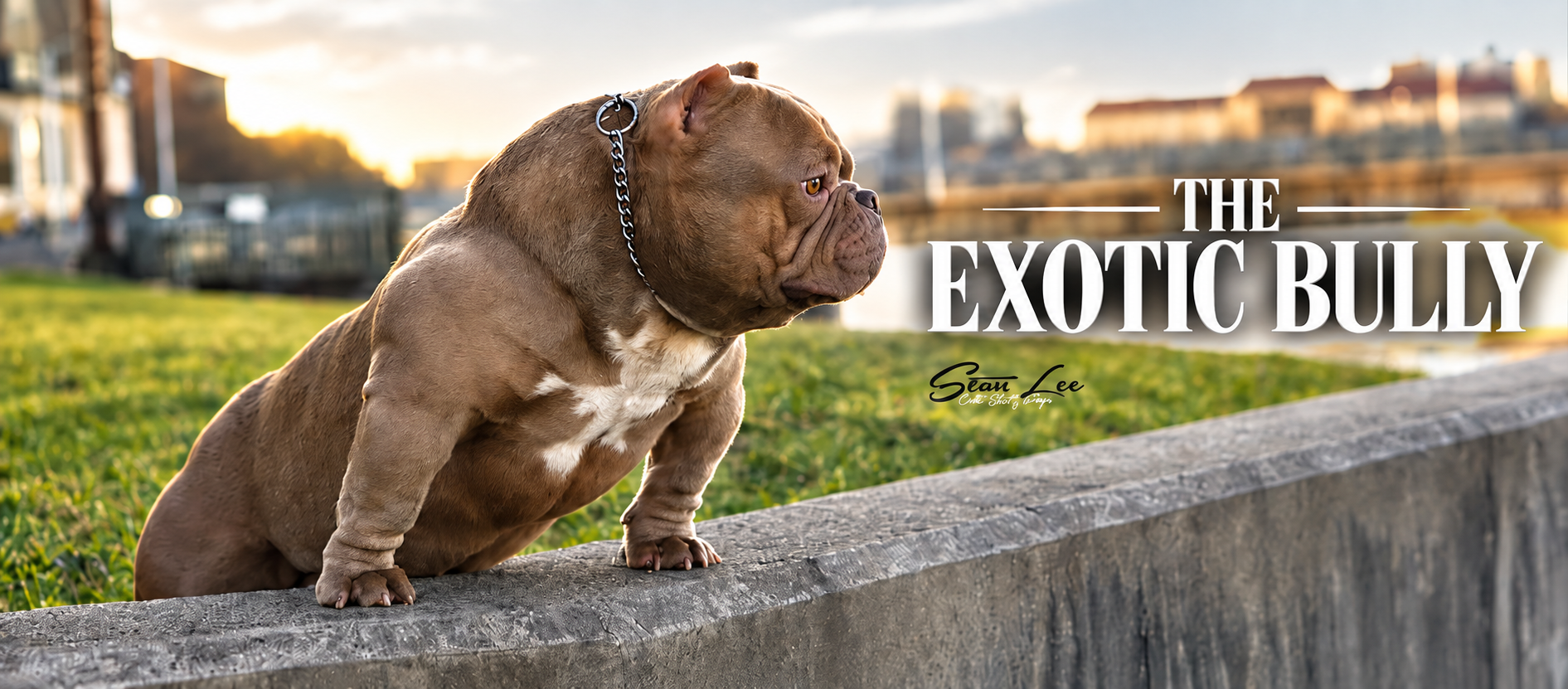
An Exotic Bully was a smaller, more compact bully-type dog selected for more exaggerated features and stronger Bulldog influence than the traditional American Bully.

Common features included:
- Very compact height
- Heavy bone
- Broad, exaggerated head type
- Short muzzle
- Wide chest
- Dense body mass
- More pronounced Bulldog influence
That definition also explains why the Exotic Bully should not simply be called another American Bully size class.
The primary ABKC American Bully varieties remain Pocket, Standard, Classic and XL.
Neither Micro nor Exotic should be presented to buyers as additional official ABKC American Bully varieties.
That does not mean those terms have no meaning inside the bully community. It means buyers should understand exactly what a breeder is describing.
.png)
How the Exotic Bully Movement Developed
By the late 2000s and early 2010s, a group of breeders had begun developing dogs that moved increasingly far away from the conventional American Bully look.
One of the names most closely associated with the early Exotic movement was Bullycampline's Mr. Miagi.
As the style became more popular, separate registries and organizations began attempting to define what exactly an Exotic Bully should be.
Historical descriptions acknowledged Bulldog influence and the use of breeds outside the traditional American Bully gene pool during development.
Different registries disagreed on specific details.
But most agreed on the overall direction:
shorter, more compact dogs with heavier bone and more exaggerated features than the conventional American Bully.
And that is where the controversy started.
People who loved the new style saw something visually different and exciting.
Critics saw dogs moving farther from functional American Bully structure.
Both things could be true at the same time.
What Is a “Clean Exotic”?
By 2018, one phrase was spreading through Exotic Bully groups faster than almost anything else:
Clean Exotic.
BULLY KING interviewed breeders and members of that emerging movement because there was no universally agreed definition.
The common theme was surprisingly straightforward.
The goal was not to remove the exaggerated Exotic appearance.
It was to produce that appearance with:
- Better feet
- Stronger pasterns
- Cleaner fronts
- Better elbows
- A more functional topline
- Better proportion
- Less structural distortion
- More stable movement
The original discussions generally described a Clean Exotic as short and compact, often around 13 inches or below, while retaining a large head, short muzzle, pronounced cheeks, significant bone and exaggerated bully type.
In other words:
cleaner did not mean smaller head, less bone or less type.
It meant eliminating defects that had somehow started being defended as desirable traits.
The Structural Problems We Were Criticizing in 2018
The original article was intentionally blunt.
Too many dogs were being marketed as “extreme” when what people were really looking at were structural defects.
Easty-Westy Feet
Feet rotating outward dramatically were sometimes excused as part of the style rather than treated as a structural weakness.
Disconnected Fronts
Elbows protruding excessively outside the supporting structure of the body were sometimes promoted as desirable exaggeration.
High Rears & Roach Backs
Unbalanced toplines became common enough that some buyers stopped recognizing them as structural faults.
“Limousine” Bodies
Extremely long bodies on very short legs frequently destroyed the compact, balanced appearance breeders claimed they were selecting for.
The point was never:
“Exotics are bad because they look different.”
The point was:
A fault does not become a feature just because enough people start rewarding it.
Photoshop, extreme posing, wide-angle distortion and carefully selected photographs can still make a structurally weak dog look dramatically better online than it does standing naturally or moving in person.
Natural movement video remains one of the simplest tools buyers have for separating presentation from actual structure.
Micro Bully vs Exotic Bully: They Are Not the Same Thing
This is one area where our perspective has changed substantially since the original 2018 article.
Years ago, very short Bullies were frequently grouped together under terms such as:
- Micro
- Super Pocket
- Micro Exotic
- Clean Exotic
That blurred distinctions that matter.
| Factor | Micro Bully | Exotic Bully |
|---|---|---|
| Primary idea | Exceptional compactness or very short bully-type structure | A distinct exaggerated, Bulldog-influenced bully style |
| ABKC class? | No separate Micro class | No Exotic American Bully class |
| Bulldog influence required? | No | Historically much more associated with the Exotic direction |
| Typical emphasis | Compact size while potentially retaining recognizable American Bully type | More exaggerated head, muzzle, width and Bulldog-influenced type |
| Quality range | Can range from functional compact Bullies to highly exaggerated dogs | Ranges widely, but structural exaggeration remains a significant issue |
A dog being very short does not automatically make it an Exotic.
And a breeder using the word Micro does not automatically tell you what breed type, pedigree or structural direction produced that dog.
Our 2026 View of Micro Bullies Is More Favorable
The word Micro became associated with a lot of bad breeding because extremely short dogs were often produced alongside increasingly extreme features.
But time has made one thing clearer:
compact size itself is not the problem.
There are very short bully-type dogs today with:
- Substantial bone
- Strong head type
- Tight feet
- Functional fronts
- Balanced toplines
- Usable movement
- Open airways
- Stable temperament
That matters.
A well-built 12- or 13-inch dog should not automatically be dismissed simply because someone calls it a Micro.
The label still needs context because there is no universal ABKC Micro standard.
But the quality of the actual dog matters more than our opinion of the word printed in the advertisement.
Modern Micro Bully Education
For the current distinction between Micro terminology, compact American Bully type, size claims, structure and buyer verification, use Venomline's Micro Bully Guide .
Has the Exotic Bully Improved Since 2018?
Yes.
And no.
There are unquestionably breeders today producing much cleaner Exotic Bullies than many of the dogs circulating when this article was first published.
There are individual Exotics with:
- Better feet
- Cleaner fronts
- Stronger rear assemblies
- More balanced toplines
- Better movement
- Improved breathing
- More proportional structure
Those dogs deserve credit.
Several parts of the modern Exotic community are also talking far more seriously about movement, structural support, symmetry and function than they were eight years ago.
That is progress.
But if we're evaluating the category as a whole rather than selecting its best examples, the Exotic Bully still has a long way to go.

Aside from a number of genuinely nice dogs and breeders clearly working toward better structure, the broader Exotic Bully category remains highly inconsistent.
Structural defects, extreme proportions, compromised movement, poor fronts, weak feet, problematic toplines and exaggerated features are still too common to pretend the issue has been solved.
Put simply: there are some very nice Exotics now — but the overall category is unfortunately still a mess.
That isn't an attack on people who love them.
It is the same criticism we would make of any breeding community that begins normalizing physical defects because those defects happen to appear alongside a fashionable look.
The “Clean Exotic” Concept Was Actually Pointing in the Right Direction
Strip away the hype and the Clean Exotic movement had a sensible goal:
Keep the type. Clean up the structure.
That idea is even more relevant today.
- Structural balance
- Symmetry
- Weight-bearing support
- Functional movement
- Open nostrils
- Stable jaws
- Better feet
- Cleaner toplines
- Usable rear movement
Standards only matter when breeders and judges actually select for them.
What Does “Clean” Structure Actually Look Like?
Can the Dog Stand Naturally?
A dog should not require a carefully manipulated stance simply to keep its legs under its body.
Can the Dog Move?
Watch natural movement from the front, side and rear.
Can the Front Support the Body?
Massive width looks impressive only when the limbs supporting that width remain reasonably aligned and functional.
Are the Feet Tight?
A compact dog should not need dramatically rotated feet to support itself.
Does the Topline Make Sense?
Look beyond the stack and watch the dog walking naturally.
Can the Dog Breathe Comfortably?
An extremely short muzzle should make airway evaluation more important, not less.
Is the Dog Proportional?
Exaggeration can still look intentional and powerful without becoming distorted.
Buying a Micro or Exotic Bully: What Should You Verify?
Do not buy the terminology.
Buy the evidence behind the dog.
- Ask for measured adult height
- Ask what registry appears on the paperwork
- Review the pedigree
- See both parents when possible
- Request current natural movement video
- Look at mature previous productions
- Ask about breathing and exercise tolerance
- Review written health terms
- Read the contract before sending money
- Verify exactly what breeding rights are included
If You're Breeding for Extreme Type, Your Standard Should Be Higher
Extreme traits increase the breeder's responsibility.
- Very short stature
- Heavy bone
- Very broad fronts
- Large heads
- Short muzzles
- Dense body mass
The answer cannot be: “That's just how Exotics are.”
Not when better examples exist.
Researching Compact American Bully Genetics?
Venomline's current American Bully stud lineup includes pedigrees, mature measurements and production information for breeders comparing compact, proven American Bully bloodlines.
Where Venom & Super Skittles Fit Into This Conversation
The original Clean Exotic discussion briefly created confusion around two dogs BULLY KING readers already knew well: Louis V Line's Venom and Super Skittles.
Both were extremely compact.
Both had substantial bone and head type.
Both could visually fit many of the physical descriptions people were using for a Clean Exotic at the time.
But they did not come from Exotic lines and were not examples of the heavy Bulldog-influenced Exotic direction.

That distinction matters even more today.
A very short American Bully-type dog should not automatically be relabeled an Exotic simply because of its height.
2018 vs 2026: What Changed?
| Topic | 2018 | 2026 View |
|---|---|---|
| Micro terminology | Frequently mixed together with Exotic and Super Pocket language | Better understood as a compact-size descriptor that does not inherently mean Exotic |
| Clean Exotic | New movement trying to remove obvious structural defects | The underlying idea remains valid and has influenced newer structural standards |
| Exotic Bully quality | Extremely inconsistent with major structural concerns | Better individual dogs exist, but category-wide inconsistency remains substantial |
| Structure | Faults frequently defended as “extreme” type | More breeders openly discuss function, movement, symmetry and support |
| Buyer education | Mostly dependent on breeder groups and social media | Buyers now have greater access to video, pedigree records, registry standards and mature productions |
Our Position Has Evolved — But the Standard Hasn't Changed
BULLY KING Magazine is more open to Micro Bullies today than we were when Micro, Exotic and Super Pocket terminology were constantly being mixed together.
We've seen enough dogs over the years to know that exceptional compactness does not automatically create dysfunction.
There are some outstanding compact dogs.
There are some excellent Micros.
There are even some very impressive Exotic Bullies.
But there is also still far too much bad structure being marketed as “extreme.”
The Exotic category has improved at its best.
At its worst, many of the same problems we wrote about in 2018 remain visible.
If a dog is short, wide, massive and exaggerated — great.
Now make sure it can stand.
Make sure it can move.
Make sure it can breathe.
Make sure its body can actually support the look breeders worked so hard to create.
That's not asking breeders to make the dogs less impressive.
It's asking them to make impressive dogs better.
Exotic Bully & Clean Exotic FAQ
What is an Exotic Bully?
The Exotic Bully is a bully-type breeding direction known for compact size, heavy bone, exaggerated head type and stronger Bulldog influence than the traditional American Bully. It should not be presented as another official ABKC American Bully size class.
What is a Clean Exotic?
Clean Exotic is a term developed within the Exotic Bully community for dogs that retain exaggerated Exotic type while improving structural problems such as weak feet, poor fronts, unstable toplines and dysfunctional movement.
Is a Micro Bully the same as an Exotic Bully?
No. Micro generally describes exceptionally compact bully-type dogs, while Exotic refers more specifically to an exaggerated, Bulldog-influenced breeding direction. The labels can overlap, but they are not automatically interchangeable.
Is Micro Bully an official ABKC class?
No. The ABKC American Bully varieties are Pocket, Standard, Classic and XL. Micro is a commonly used descriptive or market term rather than a separate ABKC variety.
Is Exotic Bully an official ABKC American Bully class?
No. Exotic Bully should not be confused with an additional ABKC American Bully variety.
Are all Micro Bullies unhealthy?
No. Compact size alone does not determine health or structural quality. Individual dogs should be evaluated for movement, breathing, structure, temperament, pedigree and health documentation.
Are all Exotic Bullies unhealthy?
No. There are structurally cleaner and more functional individual Exotic Bullies. However, the category remains highly inconsistent, and exaggerated structural problems continue to appear frequently enough that buyers should evaluate each dog carefully.
What should a Clean Exotic look like?
The concept generally calls for a compact, exaggerated Exotic appearance combined with tighter feet, stronger pasterns, cleaner fronts, better proportion, more balanced toplines and more stable movement.
How can buyers evaluate an Exotic or Micro Bully breeder?
Ask for measured adult dogs, natural movement videos, registration records, pedigrees, mature previous productions, written health terms and evidence that supports the breeder's claims.
Continue Your Research
Preserving the Original BULLY KING Publication
The underlying article was originally published by BULLY KING Magazine on July 31, 2018 and later accumulated more than 250,000 reads through the publication's Medium audience.
This substantially expanded edition preserves the original article's central historical observations while separating 2018 industry terminology from BULLY KING Magazine's current 2026 editorial position.
Updating the article does not replace, supersede or reset the chronology of the original publication.